A pharaoh appears in the American desert — and makes its Paris debut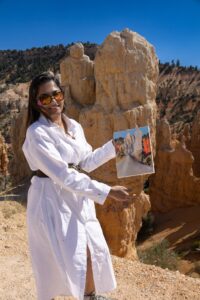
Indian painter Sumedha Ramanan’s modest canvas from Bryce Canyon finds its first public home at 55 rue Monte Cenis, an address long known to artists
By Rameez Makhdoomi
Paris: More than a century after the treasures of Tutankhamun first astonished this city, another pharaoh has arrived in Paris. This one was never buried in the Valley of the Kings. It was found, quite by chance, in the weathered rocks of Bryce Canyon by the Indian painter Sumedha Ramanan, and it now hangs at ARRIVAL Gallery, 55 rue Monte Cenis — a quiet, storied address that has for generations drawn artists seeking both refuge and recognition.
The Pharaoh of Bryce Canyon, a compact oil on canvas measuring just ten by eight-and-a-half inches, belongs to Ramanan’s series Kings of the Canyon. She did not set out to paint an Egyptian profile. Working strictly en plein air, she met the landscape under a moving sky and changing light. The suggestion of a face emerged through the act of looking. The rocks supplied the forms; the human eye completed the recognition.
Ramanan’s method is exacting. She paints wet-on-wet on pre-mounted canvases, carrying them into difficult terrain and refusing to retouch the work once she leaves the site. What remains on the surface is the encounter itself — the temperature of the air, the wind, the colour that appears and vanishes before it can be fully claimed. “I am interested in what happens when you respond to a landscape in real time,” she has said. “The light changes, the colours shift, and you have to make decisions before the moment is gone.”
For readers unaccustomed to the American deserts, Bryce Canyon can seem almost unreal: a vast amphitheatre of pink and ochre hoodoos sculpted over millions of years. Ramanan treats it neither as spectacle nor as backdrop. Her earlier expeditions through Canyonlands and Arches, and later her work beside the high, wind-scoured shores of Pangong Tso and in the Nubra Valley, reveal a consistent temperament — a willingness to meet spare, monumental landscapes on their own terms.
The painting’s small scale is deliberate. It does not dominate a room; it invites the viewer to come closer and stay longer. In an age of rapid images, it asks for a slower kind of attention.
Ramanan is currently on a painting expedition in the Arctic, working at night under the aurora borealis while still obeying her central rule: everything is painted on location from life, without later retouching. Night-time plein-air work is the next chapter. Readers who wish to follow the journey will find it unfolding at @enpleinairusa.
The canyon remains in Utah, shaped by deep time. The pharaoh waits in the rocks. Look closely, and see what appears.